Elevating voices: UX as a tool for equity

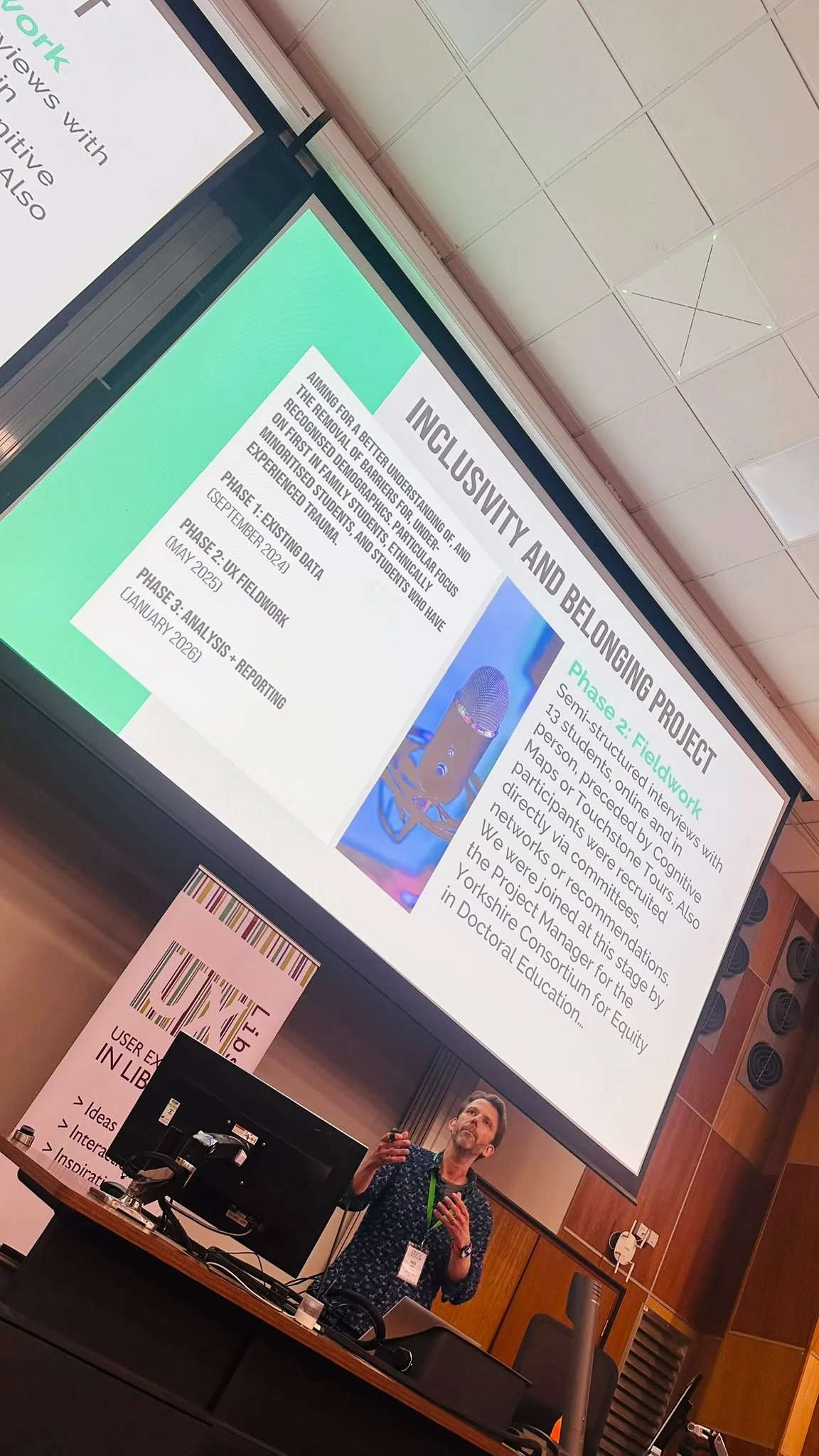
Today I am honoured to give a keynote at UXLibs 10, the User Experience in Libraries Conference. Below is a version of my slides, and then I’ve linked to several relevant articles and reports covering things I discussed in the talk, finishing with highlights from my report on the Inclusivity and Belonging UX project at the University of York.

The presentation

My slides are embedded below and available on Slideshare here.

The abstract

Higher Education is facing financial crisis. When budgets tighten, services often shrink to fit the needs of the majority, and ‘maintaining core services’ can easily become a proxy for exclusion. By designing for the ‘typical’ user – those with the fewest barriers and the most flexibility – we inadvertently sideline marginalised groups with complex needs.

This keynote positions UX work as an essential tool for equity, with a five point manifesto. We will explore how libraries can represent the under-recognised, elevate diverse perspectives and ensure our institutions remain inclusive, authentic spaces for everyone.

Recruiting for diversity

An absolutely essential part of my UX manifesto is to recruit as diverse a group of fieldwork participants as possible, rather than taking a first-come, first-served approach, or trying to achieve a representative sample. Your service will be more inclusive if you design it to meet the most needs, rather than for the most people. I cover this and several other aspects of communication around UX in ‘Communicating the benefits of UX to everyone who needs to hear it’ in the User Experience in Libraries: Yearbook 2024 edited by Andy Priestner and Marisa Martin (2024) - the Open access version available via White Rose Research Online here.

Three rounds of five, and getting UX done

A really effective structure for UX projects is to interview 15 participants, split over three rounds of five people each. The first round is generative, the second round is for prototyping, and the third round is evaluative. This process is covered in more detail, along with some advice on how to advocate for UX and get it done at your institution, in ‘Ask not what your organisation can do for UX; ask what UX can do for your organisation,’ in User Experience in Libraries: Yearbook 2023, edited by Andy Priestner (2023). The Open access version of that is available via White Rose Research Online.


The Inclusivity and Belonging Report

Throughout my talk I referred to a recent UX project at the University of York, entitled Inclusivity and Belonging. The report was written for use within the University and it wouldn’t be appropriate to share all of it - however, below are some highlights, with the quotes from participants removed.

Executive Summary

Our spaces help shape the daily experiences of our users, and should reflect the communities that use them as far as possible. This project originated from the need for better data on the library experiences of students from smaller, under-recognised demographics. We have consistently prioritised diversity in participant recruitment for previous User Experience (UX) projects, but rarely have we made that diversity the focus of the project itself; while we have made good strides in specific areas relating to inclusivity, there are many groups outside the ‘typical’ York student, who face barriers to service use which we could potentially remove. In particular we wanted to focus on the experiences of first-in-family students and ethnically minoritised students, and to make the library a more trauma-informed service, as part of this project. There was intersectionality here among our participants, both in terms of class and race, and in terms of neurodiversity.

Key findings and observations

The Library is widely regarded as an inclusive environment, but this perception is carried by the interpersonal skills of our staff, our communication online, and specific initiatives (such as the Sensory Rooms or Family Study Room) - rather than the building itself.

  • Staff are a key part of inclusion. Students frequently praised the approachable and welcoming nature of library staff, especially in the Customer Services Team. In general, the library's approach to inclusion and belonging is actively noticed, and appreciated.

  • Elements of the physical environment - often beyond the library's control - actively work against inclusion. Several safety features required by the University - such as the turnstiles, high-intensity lighting, and glass-fronted study rooms - act as signals of exclusion for marginalised groups. In contrast, spaces like the Spring Lane Building are perceived as more inclusive despite being unstaffed: this is attributed to the absence of turnstiles, more thoughtful lighting, and flexible furniture configurations. However, those spaces do not foster a sense of belonging in the same way the library does.

  • Louder study spaces are important. Students from marginalised groups often feel exposed or scrutinised as they move through University spaces. Silent or very quiet study areas heighten this feeling of hyper-vigilance, whilst louder, Studious Buzz areas help to reduce the exposure, helping students feel more at ease. (This is a key reason one of the outcomes of this project, the Ethnically Minoritised Author Showcase Space, is located in the Fairhurst rather than the Morrell.)

  • Students from marginalised groups experience information gaps. We know from the 'York Risks' work from the No Gaps Project that 'Without a sense of belonging, students may feel isolated, excluded and marginalised, leading to lower engagement in learning, support and university life.' Students from working-class or ethnically minoritised backgrounds often operate under a constant state of "decoding" the university environment. This cognitive overload leads to missed opportunities within the library - such as students unnecessarily purchasing books, failing to seek help, or overlooking available services.

Outcomes and recommendations

This report details findings across 8 key themes and offers 19 recommendations. Rather than waiting for the publication of this report to take action, we adopted an iterative approach. As a result, over half of the recommendations are already complete or well under way.

Methodology: a UX-led approach

User Experience

As with all major projects, we based our approach around User-Experience (UX) methodologies. The best way to hear from students is not through focus-groups or surveys but through one-to-one conversations. The data we get from a semi-structured interview is so rich that only a small sample size can yield incredibly useful - and actionable - insights.

Project Overview

The project began in September 2024. Phase 1 focused on existing data: we met with around 10 staff from around the University to assemble perspectives and documentation from related studies. Phase 2 was the UX fieldwork, beginning in May 2025 and running until January 2026; we spoke to 13 students recruited directly, via channels such as Step Ahead or recommendations from relevant staff. Phase 3 - thematic analysis and reporting - began in January and ended in April 2026.

The project group consisted primarily of Ned Potter, Clare Ackerley, Martin Philip and Olivia Else, all from the Faculty Librarian Team, and we benefited from three later additions to the group. Raj Mann (who was at the time Project Manager for the Yorkshire Consortium for Equity in Doctoral Education) joined us for two months of the project, bringing invaluable expertise on many pertinent areas including providing a safe environment for interviewing students on potentially traumatic subjects, and introducing us to the term Trespasser Syndrome (more on which below).

Sarah Lapacz and Emanuela Buizza from the Customer Services Team joined up after most of the fieldwork was conducted, to help with thematic analysis and recommendations. Having their perspective and fresh eyes on the data was really valuable, and I'd recommend this approach of involving new people at the analysis stage for future UX projects going forwards.

A note on terminology

We use the term under-recognised groups rather than under-represented groups, which is the phrase we typically see used in the University. Even though it is almost always not intended this way, there is an implication with the latter term that the onus is on the marginalised person to represent themselves better, whereas of course the reasons for under-representation are systemic and institutional.

We use the term ethnically minoritised students rather than BAME or Black, Asian and Minority Ethnic students, based on advice from specialists in Diversity, Inclusion, Equity and Belonging. This framing highlights the fact that Black and Asian students' minority status at the University is an active, systemic process, rather than a static identity. Talking about 'BAME students' also risks implying a homogonisation of very diverse experiences.

We use the term Trespasser Syndrome where the University often used the term Imposter Syndrome. Imposter Syndrome individualises suffering: it’s not something being done to you; it’s something you ‘have’, a personal flaw that comes from within. But students from marginalised groups are made to feel like outsiders by the University - that comes from without. To quote Dr Arin N Reeves: "People from under-represented groups are not afraid that they are imposters; they are afraid that the majority groups won’t see them for who they are and won’t welcome them if they do see them. These fears are not the fears of imposters; they are the fears of trespassers."

Findings

1) Standard library environments can be exclusionary to marginalised students.

Large, bright, open study areas (such as Morrell Floor 1 or the Burton) are perceived as overwhelming and high-pressure spaces.

It was notable that this was the one area in which ethnically minoritised students, first in family students, students who have experienced trauma, and neurodivergent students all reported similar experiences and issues: the discomfort that comes from feeling observed ("it's just eyes and heads"), or 'taking up someone else's space' in an environment in which they already feel like a trespasser.

2) Bright fluorescent lighting is a source of overstimulation, especially for neurodivergent students. We know from previous UX projects that students want controllable lighting (such as desk lamps) or dimmer zones within the library - this was further confirmed in the fieldwork here. The natural light from windows is appreciated, but strong internal lighting is not.

3) There is a demand for semi-enclosed "micro-spaces". Students want the comfort and privacy of a "little house" while remaining in a public study environment rather than in an isolated area where they feel vulnerable.

Student needs are not as straightforward as wanting to study in busy areas, or quiet areas, or secluded areas. They require different combinations of good sight-lines, whilst not being overlooked; being private whilst not being isolated; feeling not just more scholarly but more inspired than they would at home.

4) The Hidden Curriculum causes financial stress in the library context. The hidden curriculum a wider issue across the University, but in the library it manifests in students not knowing that textbooks are available for free or that online copies exist, leading to unnecessary financial worries. There is also a lack of understanding around borrowing, returning and requesting books which is exacerbated for any students who feel othered or like they don't belong, as they're less likely to seek out help for their problems.

5) The lack of a quiet, segregated prayer space within the library is a functional barrier to long-term study for Muslim students. We know there are many reasons why a prayer room is not currently possible in the Library - however it continues to be raised in the research, every time we speak to students, even if we don't ask about it. Any student needing to pray during their study faces a stark choice - the discomfort of public, overlooked prayer in the library, or losing time (and potentially their study space within the building) by needing to travel to a prayer room elsewhere on campus.

6) Inclusion and belonging can come from exhibitions and events in the library. When we asked what could make the library more inclusive, several students talked about events or exhibitions as being key to seeing themselves (and those of other cultures) in the space.

7) The library is considered a diverse space. The majority (though not all) of ethnically minoritised students we spoke to considered the student body who use the library to be relatively ethnically diverse.

However it was notable that working class students are keenly aware of how many private school educated people are in the wider University. Several mentioned feeling othered by this.

8) Library staff are considered open, helpful and approachable. Many students report positive interactions with library staff, including ethnically minoritised students who have not had positive experiences elsewhere on campus. This is a real strength in the library which we should continue to build on.

For many of our participants, asking for help at all is significant. We need to continue to encourage and reward help-seeking behaviour at all times, and to foster non-direct forms of communication - students told us they'd prefer to DM on Instagram than speak to a member of staff face-to-face when seeking help, for example.

As mentioned in the executive summary, it is my belief that the staff of the library go a long way towards mitigating the more exclusionary aspects of our buildings and services, and are a key part of why we are widely considered to be a very inclusive space within the University.

Recommendations

There were 19 recommendations, many of which are complete. A selection are mentioned below.

  1. Ethnically Minoritised Author Showcase Space (completed): This collection was suggested by Raj Mann as a way to celebrate ethnically minoritised authors and make the library a more inclusive environment. It began with the purchase of around 500 books, and rather than selection being driven by the library each item was a recommendation from students or staff at the University. To ensure these books remain accessible throughout the library, we purchased dedicated copies specifically for this room rather than moving existing stock. There is a QR code in the room where students and staff can suggest additional purchases for the collection: these are reviewed twice a year in Collections Community.

  2. Add tags to study spaces in LibCal to aid students affected by trauma in choosing where to work (completed): The LibCal booking system now has additional checkable boxes when searching for study spaces. These allow you to filter the spaces and, for example, show only spaces with good sightlines, or spaces where you're seated with your back to the wall.

  3. Add blinds to study rooms to allow privacy for prayer (completed): we have had bespoke blinds fitted to two Morrell bookable study rooms (on Floors 1 and 2) to allow students privacy to pray

  4. Offer bespoke Library Tours for relevant Student Communities particularly First in Family groups

  5. Introduce more cultural event programming within the Library buildings. We will also explore offering LFA/144 as a safe, warm, well-lit event space for EDI+B related events at evenings and weekends, for student groups and societies.

  6. Better promotion of money-saving and no-cost services in the Library ideally in collaboration with Central Comms channels where possible

  7. Expand the glossary of library terms (in progress): our current glossary is focused on library terminology: we want to expand this to cover more colloquial and idiomatic territory, to help those adapting from other countries. Will include English and Yorkshire based expressions, as well as the usual definitions of library jargon such as 'quartos'.

Conclusions and future work

This project has taken a year and half to explore the experiences of several communities, and this has been extremely successful. However, in the future we aim to undertake smaller UX projects with specific communities to understand their needs better. This more agile approach would see us undertake three projects (interviewing 5 participants each rather than 15) each year, focusing on one group at a time.

The Library must continue to be an exemplar across campus in investing in, and genuinely believing in, inclusivity. The user voice is key to this, and this project has shown how valuable it is to continually undertake research directly with the student (and staff) population to inform our decisions.

We need to work to mitigate some of the systemic issues beyond our control. We can't solve all the problems we identified, but our experience from previous UX projects has shown people really appreciate any efforts to reduce the impact of the issues - see for example providing blankets because we don't have the ability to make our buildings warmer. What are the blanket equivalents for the issues identified in this project?

We need to ensure that designing for the typical York user doesn't become a proxy for exclusion. When budgets tighten, services often shrink to fit the needs of the majority: when we design for those with the fewest barriers and the most flexibility we can inadvertently sideline marginalised groups with complex needs. UX projects like this one are an essential tool for equity, elevating diverse perspectives and ensure our library remains an inclusive, authentic spaces for everyone.

Ned Potter, April 2026
Ten tiny tips for preparing a talk

I love prepping a talk, which is what I've spent the last few days doing ahead of my keynote at #UXLibs 10s today. Here are some things I've found helpful in the process.

1) Get your ideas down first; sort the visuals later. Think of it like building a house - you lay the foundations and see the walls are going before you pick furniture and colours... Sometimes the content can dictate the style, too.

2) Make a version with everything you want to say. Don't worry about timings or length at this stage.

3) Practice, out-loud, like you mean it. You cannot practice a talk in your head - you'll unknowingly take shortcuts and find yourself facing a slide on the day and not knowing how to actually express yourself. To get the language right you need to do it at full volume, as some things (especially colloquial phrases) just don't work when you're projecting your voice.

4) Time the your talk. The chances are it'll be long; that's fine. It's easier to make it long and work out what to cut, than it is to try and make it the right length in the first place where you might accidentally leave out more impactful themes or framings.

5) Get it the right length, then cut another 10% off anyway. Things always tend to go longer than you think at conferences. Or maybe there's a tech issue, or the host's intro takes too long. It's better to be too short than too long, because the latter eats time from other speakers. So if you have a 40 minute slot, prepare 36 minutes; for a 10 minute slot, prepare 9 minutes, etc.

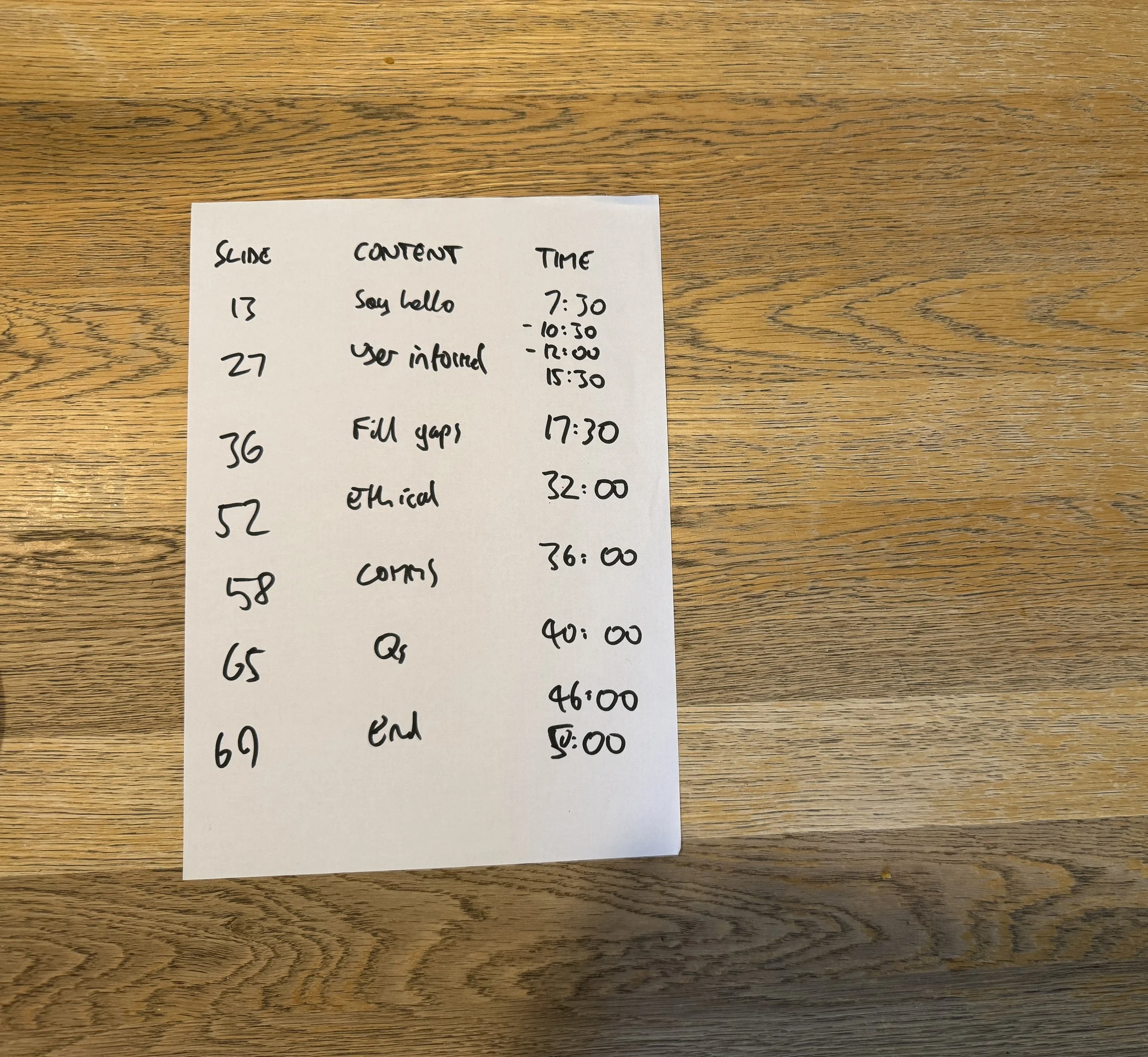
6) Run it one more time, and note the key timings of where you'd expect to be for each section. I've posted a picture of mine below (forgive my handwriting). The idea is if I get to, say, slide 36 and I'm already on 20 minutes, I'm going long and need to tighten up and compensate. This is a *really* useful piece of paper to have in front of you in a talk.

Sheet showing talk timings, e.g. Slide 52, 32 minutes in

7) Don't put questions right at the end. I think it's better to put questions 5 minutes before the end, then answer the questions and do your final summing up - end the talk on your terms.

8) Add the alt-text (assuming your slides will be shared afterwards). I use a lot of boxes as part of my slide design, and it takes a while to mark them all as decorative, describe my graphs etc.

9) Make a sharing version. The slideshare edition of my slides may have slightly more text on, and I'll have hidden slides which don't make sense without any context, before saving the PDF.

10) Save it to a stick, save it to your laptop, AND upload it to the Cloud... That should cover almost any eventuality!

If there are any tips would you add, let me know in a comment! The next post on here will be my slides and relevant links from the UXLibs talk. I love running Presentation Skills training and workshops, so if you’d like to book something bespoke for your organisation, you’ll find details of what I offer and feedback from previous workshops towards the bottom of my Training page.

I have redesigned this website and now it is better

If you’re reading this I salute you: I know no one really cares about website redesigns except the owner of the website, so I appreciate you casting your eyes over this!

I’ve had a website since 2010 and have re-done or updated it several times over this period. At the same time I’ve done a lot of UX work around updating the website of the Library I work at - and I realised I’d failed to apply those user insights to my own site… It was built around all the things I wanted to say, rather than around the user experience or what the audience actually wanted to know. I also looked at Analytics and realised some pages just didn’t get viewed at enough to earn their keep. So I spent a quite painful day rebuilding it - and took the opportunity to tweak the visuals a bit and make the whole thing feel a little more modern, and have more teal in it, because teal is my favourite colour.

Kill your darlings

One of the main things I’ve done is take pages away. There was a Drums page linked from the About page, because I’m a drummer and I love drums, but it just isn’t really relevant so it’s gone. There were pages with detailed breakdowns for orgs about each workshop - tech requirements, reviews etc - but I provide that info via email to interested parties anyway, so those have all gone. Other minor pages have gone too: the more you prune the stuff people don’t need, the better the remaining content actually works for people.

The Home Page

With the exception of a few blogposts, the Home page is unsurprisingly the most popular page on the site - but it was really just a signposting page, meaning the user didn’t get much use out of it in and of itself. I noticed that other people who provide freelance training and consultancy really use their homepage to provide a full overview of what they offer - topics and themes, testimonials, clients etc. So I’ve reworked the homepage with this in mind.

The Blog, About and UX pages have received minor quality of life improvements.

The publications page

I used to have a separate page for the Library Marketing Toolkit and my other publications - this is needlessly granular so I’ve turned them into one page. I also realised I had links to buy the Toolkit on Amazon, set up over a decade ago before I’d realised quite what Amazon represent…

The Events page

Again I had a separate page for past and upcoming events - I’ve now hidden the events calendar and just include future talks and workshops in the same page.

The training and workshops page

In many ways this is the most important page for me - as a freelancer this is how people find out about what I offer. I’ve given the three broad areas I cover - social media, strategic marketing and presentation skills - more space, updated the descriptions, added some feedback and moved some other info off the page.


I hope you find what you need on this refreshed site, and if you have any training or speaking requests (or suggestions for website improvement…) get in touch!

Embracing authenticity in a sea of GenAI

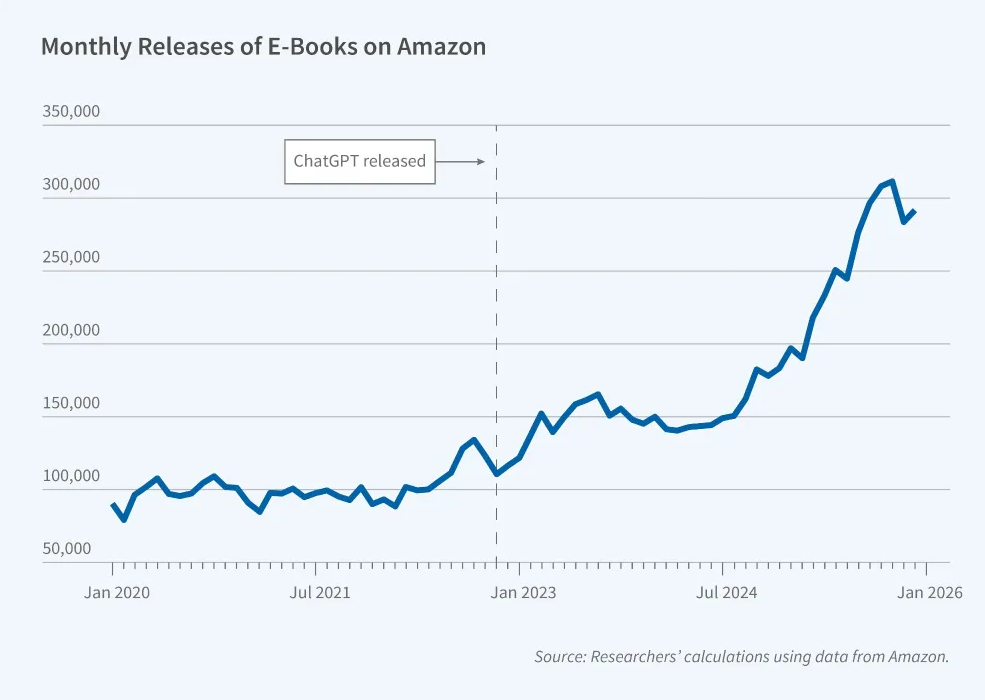
Similarly, a report from Deezer last year showed that over 50,000 GenAI tracks are uploaded every day to the music streaming platform. 50k! Every single day! We’re literally drowning in culture, eh? People use AI to generate entire bands for Spotify, then use bot farms to drive up the streams to get paid. Humans have been cut out of the loop entirely! What a time to be alive.

Forgive me for going Full LinkedIn, but this really did get me thinking about my job… and communications, and social media, and marketing, and content, and the arts. In a world in which there is an abundance of almost everything arts-related (music, visual imagery, video, literature) the only things there aren’t an abundance of are authenticity and human creativity – and they become even more valuable as a result. We need to remember this, and be prepared to swim against the tide to defend it.

This also got me thinking (stay with me here…) about mortality. The Venn diagram of tech bro billionaires who are interested in ‘longevity research’ (for which read: living for an incredibly long time beyond the expected human life-span) and who are interested in GenAI output more or less replacing human output, is a circle. I don’t think that’s a coincidence.

I’m old fashioned in that I think the thing which gives life *meaning* is it that it’s finite. When you have an infinite supply of something – be that literature, music, or even immortality itself – the overall value of it inevitably goes down. But there is (forgive me, again) an opportunity here: to define ourselves through opposition. To take the artisanal route, rather than hanging onto the coattails of mass production.  

If we end up in this landscape where 90% of what we consume is just AI slop, that means genuine cultural experiences will become incredibly valuable. Not to everyone, but to some people – and I think those people are the ones interested in arts, and culture, and education, and progress. This is how we can stand out, this is how we can engage. Do you want to be the 6 millionth account to post some second-rate GenAI imagery? Wouldn’t you rather be the exception that only posts genuine pictures? Wouldn’t you rather be part of the group who proactively reclaim music, and literature, and videography, and even something as relatively prosaic as a social media post, as something of value - and nurture that?

The social media accounts I run for my org don’t use any GenAI music, imagery or video. We post less than we would if we did use that stuff, because it certainly speeds things up. It is incredibly quick to produce marketing materials with GenAI. But most of them are basically rubbish. The frictionlessness of GenAI somehow seeps through – and no one really cares or learns, or remembers. And of course, many people will completely write you and your content off if you use GenAI in your posts or your slides or your website or your newsletter. They feel that if you aren’t prepared to create content yourself, they shouldn’t have to consume it either. They feel – whether you intend this or not – like they you are treating them with contempt when you use GenAI.

Some people will be fine with all AI slop, all the time – but a lot of people won’t. Creativity is no longer technically required to write books or music, but it is required for OUR sake as humans. We will increasingly need to reclaim art as more than just background noise and filler. We need to reclaim the ACT of creation as valuable, not just the product. And as everything else gets watered down and diluted into meaninglessness, human experiences and connectivity become more valuable than ever. Write that music. Write that book. Write that social media post using your own brain and your own words.

Don’t give in to the idea that GenAI is an inevitable, unstoppable force: challenge all of those people who say ‘AI is here now - you can’t put the toothpaste back in the tube!’. To quote my friend Simon Bowie:

“When I accidentally squeeze out too much toothpaste, I don't then shove it all in my mouth. I wash it down the plughole.”

What do we *know* about GenAI

There is an unending stream of reports, think-pieces, puff-pieces and hit-pieces on GenAI. You’d need a lifetime to get through it all even if they stopped being written tomorrow.

The trouble is so much of it is speculative. GenAI shills talk uncritically about what it may be able to do, and fudge the lines about what it is really achievable. Equally I read pieces by GenAI skeptics that confidently claim ‘GenAI cannot do X’, when in fact that was true 6 months ago but the extraordinary pace of technological development means it is not true now. There’s also a lot of ‘what-aboutism’ in AI discourse - sure there’s a huge environmental cost to using it but what about email, that uses electricity too? Etc etc.

So if we try and get a handle on where we stand, and want to move beyond the back-and-forth, what do we actually know about GenAI?

GenAI erodes cognitive functioN

A 2025 MIT Study (summarised in Time here) used EEGs to record brain activity in controlled groups. The ChatGPT-using group has the lowest brain engagement and “consistently under-performed at neural, linguistic and behavirol levels.” The study lasted months and the GenAI users got worse and worse over time.

There are several other studies that document this ‘cognitive offloading’ - when we outsource creativity and criticality, we lose the ability to do it for ourselves. That makes sense: if we got someone else to do exercise for us we’d probably lose fitness, too.

GenAI doesn’t reduce workload for regular employees

Leaders and managers love GenAI. The pantomime villain bosses love it because it offers the promise of achieving the same results with fewer staff members, thus saving money. But even the well-meaning managers in the public sector seem to love it, because it offers their staff gains in efficiencies and save them time to concentrate on the things which really matter.

But does it, though?

Harvard Business Review published an article this month confirming AI doesn’t reduce work - in fact it intensifies it. In an 8 month study, they it was discovered that employees worked faster, took on more tasks and worked longer hours (for the same pay, of course) thanks to GenAI. “Once the excitement of experimenting fades, workers can find that their workload has quietly grown and feel stretched from juggling everything that’s suddenly on their plate. That workload creep can in turn lead to cognitive fatigue, burnout, and weakened decision-making. The productivity surge enjoyed at the beginning can give way to lower quality work, turnover, and other problems.”

GENAI gets things wrong a lot of the time…

The marketing genius of the word ‘hallucination’ to explain GenAI errors lies in suggesting an entity that can think for itself, and sometimes makes things up or hallucinates. In reality GenAI is a massive excercise in pattern recognition, and the process by which it gets things ‘right’ and gets them ‘wrong’ is exactly the same.

Because of this, the BBC found it misrepresents the news a massive 45% of the time. A recent report found Google Gemini is in fact returning hundreds of thousands of wrong answers each minute.

This is catastrophic.

[image or embed]

— Futurism (@futurism.com) April 9, 2026 at 12:31 AM

I don’t know a single person who has asked GenAI about something they have deep knowledge of, and still rated GenAI highly after reading the results. Not one. I don’t know a single person who has used GenAI to take minutes at a meeting, and then continued to do this after checking the minutes properly for accuracy. To use GenAI in earnest is to learn how limited it is.

…But we use it anyway

We can all talk about how ChatGPT ‘isn’t a search engine’ till we’re blue in the face, and GenAI tools can add a disclaimer saying we should ‘always verify results’ as many times as they like, but we know what humans are like - we’re not checking the results, even in incredibly important things like Police decisions, because that would take more time than just looking up the data properly in the first place.

Google Gemini is a punchline - there are countless examples of it getting things hilariously wrong in its summaries. But Google doesn’t care, because exponentially fewer people are clicking on the links in the search results - they’re staying on Google and just reading the AI.

GENAI already has a high body count

Many GenAI tools are ready to act as a ‘suicide coach’ as shown in cases already going to trial. The ‘deaths linked to Chatbots’ Wikipedia page is steadily growing. A study has been published showing how dangerous GenAI medical advice can be, with examples including bogus information about liver function tests which would mislead people with serious liver disease wrongly thinking they were healthy.

GenAI is built ENTIRELY on stolen intellectual property

The Large Language Model GenAI tools are built on data they stole - and in fact OpenAI has said it would be impossible to create tools like ChatGPT without using copyrighed material. Ah well, fair play lads - on you go, then.

GENAI doesn’t actually save most companies money

In 2025 MIT found that despite investing billions of dollars into GenAI, most major companies are not seeing any return on their investment. In fact 95% of GenAI pilots are failing.

GENAI companies themselves don’t actually make money

OpenAI make the wildly successful ChatGPT - what do you think their profit was in 2025? $1 billion? $2 billion? Not quite - they made an $8 billion loss. Their own internal documents predict a £14 billion loss this year. They’re committed to spending $1.4 trillion, with no road to profitability by 2030.

“OpenAI's losses will total $143 billion between 2024 and 2029, the "largest startup losses in history," Deutsche Bank analysts wrote in a December 4 note. HSBC researchers said in a late November report that they expect OpenAI to have a $207 billion shortfall by 2030, even when modeling for significant boosts in revenue” says Business Insider.

Anyway: the world seems all-in on this tech, but it may be prudent not to become over-reliant on it, for all of the reasons above.


Not to mention all the other things (you can find a pretty exhaustive list on Sarah Winnicki’s site) like extraordinary electricity use and habitat destroying of the data centres, the fact that one data centre can use the same amount of water per day as a town of 50,000 people, the amplifying violence against women, the huge cost to the creative industries of replacing skilled human with utter slop, the fact that GenAI’s output is racist as hell (oh and sexist, and ableist, and homophobic).

Not to mention any of the horrendousness of Grok, which really belongs in a category of its own, but sadly isn’t, because the other GenAI tools now feed off Grok to inform their own responses, as GenAI eats itself, excretes itself out, and then eats its own waste, like some sort of terrible apocalyptic dog.

And not to mention that our use of (and Government investment in) GenAI pours money into the coffers of literally the world’s worst people, because that’s just my subjective opinion, and this is post is all about what we KNOW about GenAI.

Reading all that back, it’s hard to get enthusiastic about the wide-spread adoption of this technology.